
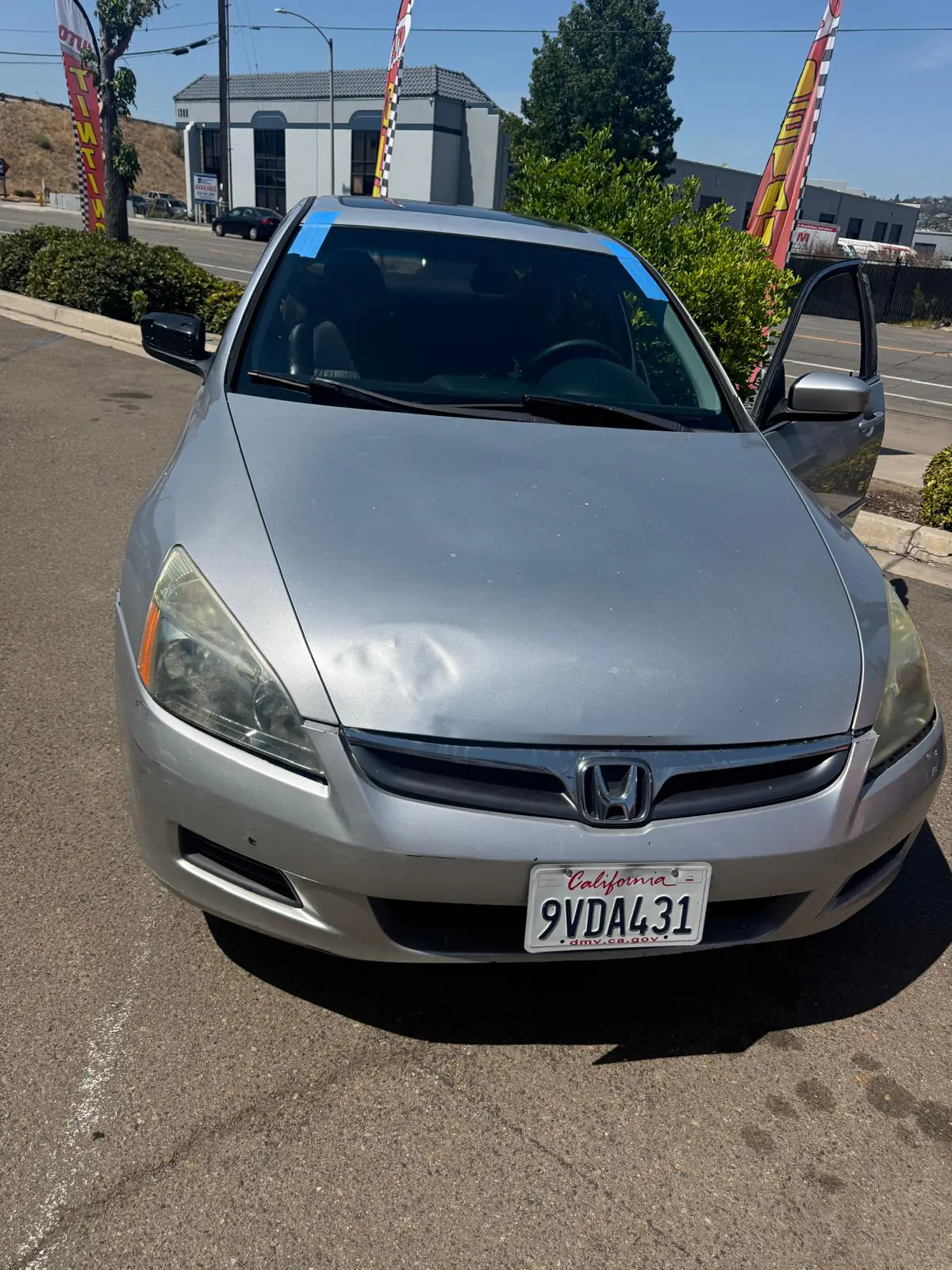
Most people have never seen a windshield get replaced. You drop the car off, you come back, there’s new glass. What happened in between is a black box — and that makes it hard to know whether the shop did it properly.
So we photographed a real job at our El Cajon shop and we’ll walk you through it.
The car is a Honda Accord that came to us with damage well past the point of repair. Once a crack spreads beyond the size of a dollar bill, or reaches the edge of the glass, resin repair stops being an option — the structural integrity is gone and the only safe fix is full replacement.
Step 1: The old glass comes out
Honda Accord with windshield removed before replacement at Cali Auto Glass & Tint in El Cajon
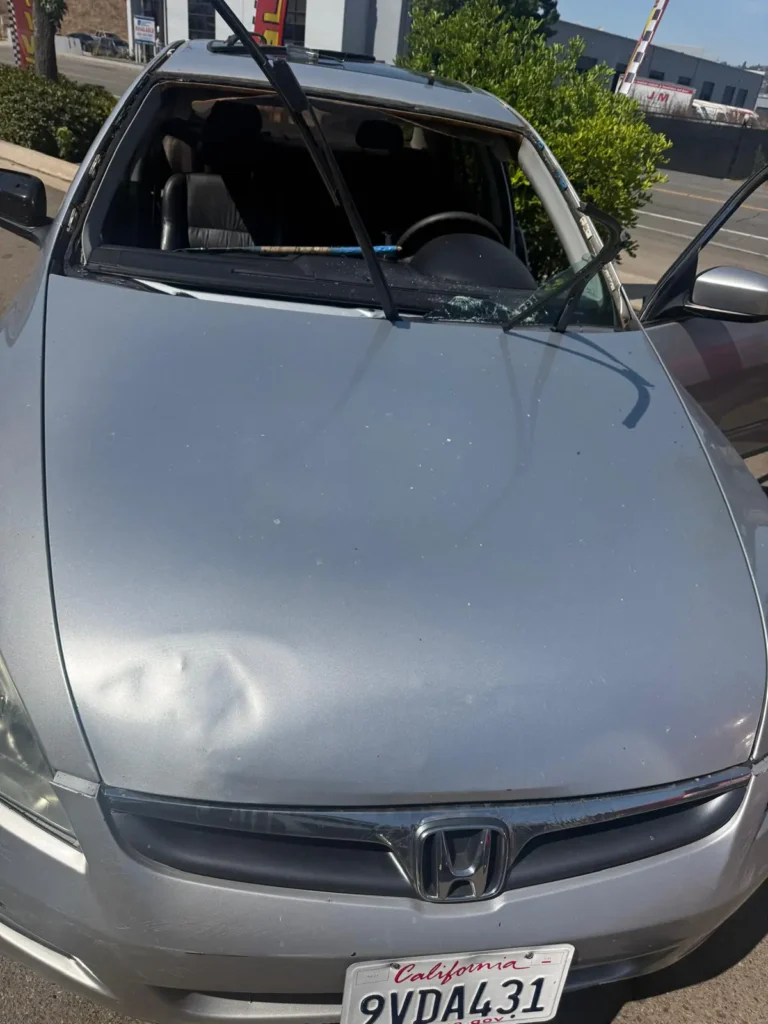
This is what your car looks like halfway through the job.
The wiper arms are lifted out of the way, the cowl trim is off, and the glass has been cut free and removed. What you can still see around the frame is the original urethane bead — the black adhesive that bonded the old windshield to the car.
That bead matters more than most people realise. We don’t scrape it down to bare metal. We trim it back to a thin, even layer and leave it in place. Cutting to bare metal exposes the pinch weld, and exposed metal on a car in San Diego County means rust — which will eventually cause leaks no amount of resealing will fix.
Trimming rather than stripping is one of the clearest differences between a careful shop and a fast one.
Step 2: Prep and priming
With the old glass out, the frame gets cleaned and the trimmed urethane is inspected for any spot where corrosion has already started. Anything suspect gets treated before new glass goes anywhere near it.
The new windshield is dry-fitted first to confirm the fit is correct for the vehicle, then primed along the bonding edge. Primer is what lets the new urethane chemically grip the glass — skip it and you get a mechanical bond that will fail.
Step 3: The new glass is set
Honda Accord with new windshield installed and retention tape during urethane cure, El Cajon
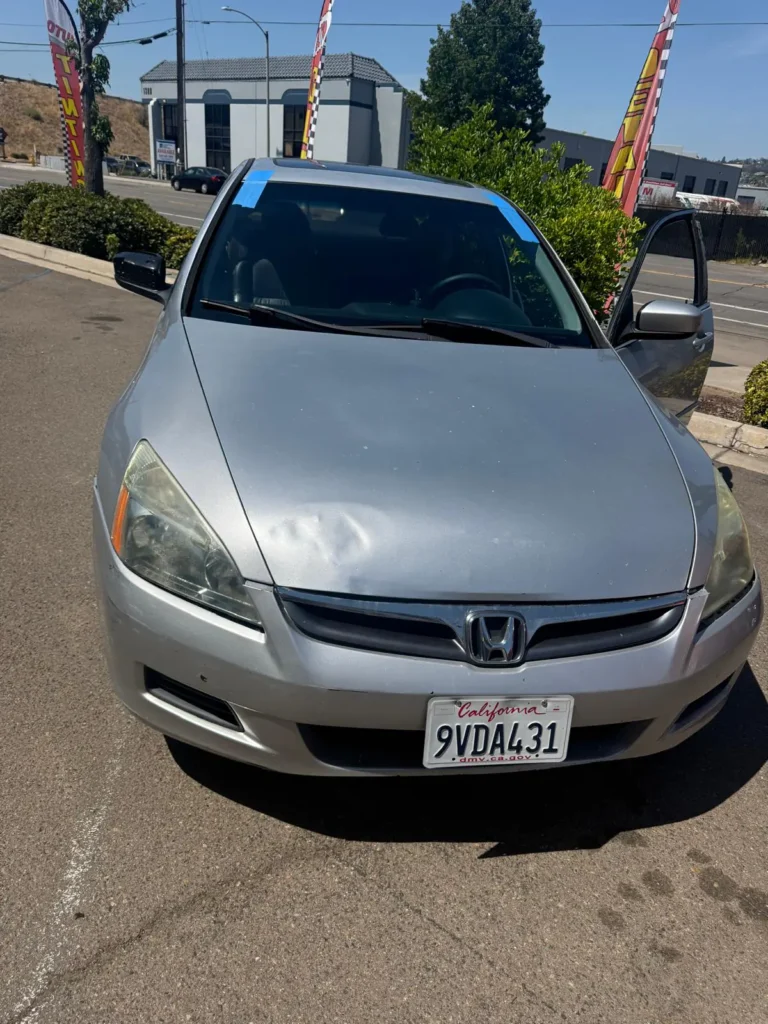
Here’s the same Accord with the new windshield in.
Those blue strips across the top aren’t packaging or decoration. That’s retention tape, and it’s holding the glass in exact position while the urethane cures underneath. Glass is heavy, urethane stays soft for a while, and gravity will pull a windshield down a few millimetres if nothing holds it. A few millimetres is enough to cause a wind leak or a water leak at the top edge.
If you pick your car up and the tape isn’t there, ask why.
Step 4: The part everyone wants to skip — cure time
The physical work takes us roughly 60 to 90 minutes. The part you can’t rush is what happens afterward.
Your car needs to sit still for at least an hour after the install. Longer is better.
Urethane cures through a chemical reaction, and until it reaches what’s called safe drive-away time, the windshield is not yet a structural part of your car. That matters more than it sounds:
- Your windshield contributes meaningfully to roof crush strength in a rollover
- Your passenger airbag deploys upward into the windshield and uses it as a backboard — if the glass isn’t bonded, the airbag can push it out instead of pushing your passenger back
That’s why we ask you to leave it parked, and why we won’t hand you the keys early just because you’re in a hurry. It isn’t caution theatre. It’s the part of the job that keeps the repair safe.
What about ADAS cameras?
If your car was built roughly 2018 or later, there’s a good chance there’s a camera mounted to the windshield behind the mirror running lane-keep assist, automatic emergency braking, and adaptive cruise.
Replacing the glass moves that camera. Even a fraction of a degree off changes where the system thinks the road is. It has to be recalibrated afterward or those safety systems are quietly operating on bad data — the warning lights may never come on.
We handle ADAS windshield calibration in-house.
Does insurance cover it?
Usually, yes — if you carry comprehensive coverage, windshield replacement is often covered with little or nothing out of pocket. We work with all the major California insurance networks and our front office will handle the claim paperwork with you.
Worth checking before you assume you’re paying full price.
Repair or replace?
Not every chip needs new glass. As a rough guide:
- Smaller than a quarter, away from the driver’s line of sight → usually repairable
- Longer than about six inches, or touching the edge of the glass → replacement
- Anywhere in the driver’s primary viewing area → replacement, because even a good repair leaves slight distortion
If you’re not sure, bring it in. We’ll tell you honestly which one you need — a chip repair is a fraction of the cost of a replacement, and we’d rather do the small job and keep you as a customer.
Start with windshield chip repair in El Cajon if the damage is small, or windshield replacement if it’s past saving.
Getting it done
We’re at 1325 Magnolia Ave in El Cajon, and we also run mobile service across East County — La Mesa, Santee, Lakeside, Spring Valley — at no extra trip charge. If it’s easier for us to come to your home or job site, we will.
Call (619) 710-6128 and we’ll tell you over the phone whether you’re looking at a repair or a replacement.
FAQ
How long does a windshield replacement take? About 60 to 90 minutes for the installation, plus at least one hour of cure time before the car can be driven. Plan on roughly half a morning.
Can I drive right after a windshield replacement? No. The urethane needs to reach safe drive-away strength first — at minimum an hour. Until then the windshield is not yet structurally bonded, which matters for roof strength and passenger airbag deployment.
Why is there tape on my new windshield? That’s retention tape holding the glass in position while the adhesive cures. Leave it on for as long as we tell you — usually the rest of the day. It’s preventing the glass from settling and creating a leak.
Will my insurance cover a windshield replacement? If you have comprehensive coverage, often yes, sometimes with no deductible. We work with the major California carriers and can help you file.
Do I need ADAS recalibration after windshield replacement? If your vehicle has a camera mounted to the windshield — most cars from about 2018 onward — then yes. Removing and replacing the glass moves the camera and it must be recalibrated for lane-keep, automatic braking, and adaptive cruise to work correctly.
Can a cracked windshield be repaired instead of replaced? Sometimes. Chips smaller than a quarter and cracks under about six inches that aren’t in the driver’s line of sight can often be repaired. Damage that reaches the edge of the glass generally cannot.